
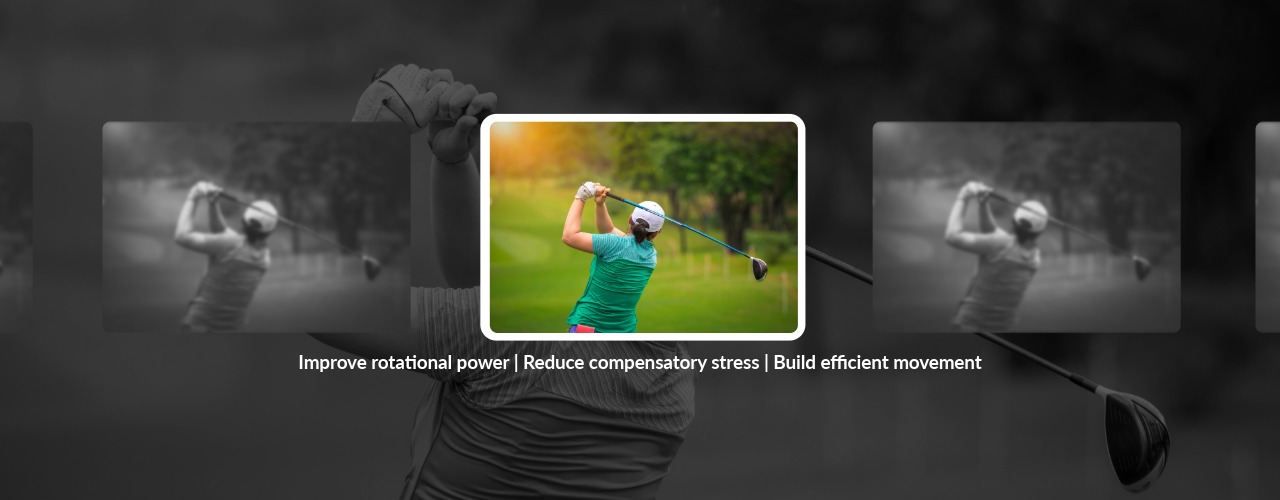
Ask most golfers what drives a good swing, and they will say rotation. They are right. But golf swing rotation is more than a technique concept. It is a physical one. What your hips, mid-back, and core can actually do determines how your swing loads your body and where problems show up over time. Research in this area has given clinicians and golfers a much clearer picture of what healthy rotation looks like and what breaks it down.
Rotation Is a Team Effort
The golf swing does not rotate from one place. It rotates from several places, working together in a specific order. The hips lead. The thoracic spine follows. The shoulders finish the turn. When that sequence works well, force moves efficiently from the ground through the body and into the club. When one part of the chain is restricted, the parts above and below it have to compensate.
That compensation is where injury begins. And it is usually quiet at first.
What Research Consistently Shows
Studies on golf swing rotation and injury risk point to a handful of findings that show up repeatedly across the literature.
Lead hip internal rotation is one of the most important physical factors in golf-related back pain. When the lead hip cannot rotate freely, the lower back rotates further than it should to complete the downswing. Over the course of a round, that adds up to a significant amount of stress on spinal structures that were not designed to absorb it repeatedly.
The mid-back is the primary source of rotational range in the swing. When it gets stiff, which happens easily with age and desk-based work, the lower back and shoulders are asked to make up for what the thoracic spine cannot provide. Research supports mid-back mobility work as one of the most direct ways to reduce compensatory spinal loading during the swing.
The separation between the hips and shoulders during the downswing is associated with both club head speed and reduced spinal stress. Improving this separation through hip and thoracic mobility work is one of the most well-supported interventions in golf rehabilitation research.
Gluteal and hip stabilizer strength is closely tied to how efficiently the body rotates and transfers force. Weakness in this area is linked to both performance limitations and lumbar injury patterns in golfers.
On the shoulder side, rotator cuff strength and shoulder blade control on the lead arm are consistently associated with shoulder injury risk. Research supports progressive rotator cuff loading and blade retraining as effective approaches for reducing that risk.
What to Expect from Treatment at PerformaX Elite Physical Therapy
A Detailed Evaluation
Research tells us which factors matter most across groups of golfers. An evaluation at PerformaX Elite Physical Therapy identifies which of those factors are relevant to you specifically.
- Your physical therapist assesses lead and trail hip internal rotation and how any asymmetry between the two sides maps onto your swing pattern and symptom history.
- Thoracic mobility is tested segment by segment to find the restrictions that are limiting rotation from the mid-back.
- Rotator cuff and shoulder blade function on the lead side are assessed under load.
- Hip strength is tested, since it’s the foundation that efficient golf swing rotation depends on from the ground up.
A Personalized Plan
Evidence shapes the plan but does not replace clinical judgment. Our team is experienced in helping golfers and typically focuses on the following:
- Hip mobility work and manual therapy targeting thoracic restrictions address the two contributors most consistently linked to swing-related back stress.
- Hip strengthening builds the proximal foundation that rotation efficiency depends on.
- Shoulder strengthening and mobility work to help protect the lead shoulder across a full season of play.
- Education about warm-up habits, round frequency, and load management gives golfers practical tools to protect their progress between sessions.
If your symptoms persist beyond a day after a round or you experience a sudden change in your ability to play, getting help from one of our therapists before the next round can help make sure you resolve any issues and perform at your best.
What Good Rotation Actually Feels Like
Golf swing rotation that works well does not feel forced. It feels free. It is a reflection of a body that has the mobility, strength, and coordination to do what the swing asks of it. The team at PerformaX Elite Physical Therapy helps adult golfers build exactly that, using a process grounded in current research and shaped by what your evaluation specifically reveals.
Get started today by calling us to schedule your first visit and let us help you find out what your rotation is really capable of!

